Curious About My Work?
A place where I address the most common questions about my photography, exploring abandoned places, purchasing prints, and how I work. Each answer gives insight into my process, approach, and how you can enjoy or collect my work safely and responsibly.
-
Irishmanlost is me, a fine art dereliction photographer documenting abandoned, forgotten, and overlooked places across Ireland and further afield.
Through my work, I focus on spaces left behind: empty houses, industrial ruins, religious buildings, institutions, and rural structures that are slowly fading from memory. I’m drawn to the quiet details, peeling paint, worn floors, and the traces of lives once lived, and I photograph these places as I find them.
Irishmanlost isn’t about chasing access or thrill. It’s about observation, respect, and preservation. I research each location, never force an entry, and never share exact locations, helping protect fragile sites from damage or exploitation.
My photography sits somewhere between documentary and storytelling. Each image is part of a wider narrative about change, decline, and the passage of time in Ireland. Many of the places I photograph reflect broader social, industrial, and cultural shifts — reminders of how quickly spaces that once mattered can be forgotten.
At its core, Irishmanlost is about slowing down and paying attention and using photography to capture the lives we’ve left behind before they disappear.
-
I don’t follow a fixed formula when naming an image. The title or short description usually comes together after I’ve spent time with the photograph, often once I’ve left the location and allowed the experience to settle.
Sometimes the name comes directly from what I see in the image itself — a room, an object, a chair by a window, or the way light falls across a space. In those cases, I keep it honest and uncomplicated, letting the image speak without adding unnecessary meaning.
Other times the title comes from outside the photograph. A song, a book, a film, or even a single line or quote can capture the mood of a place more accurately than a literal description. Those references often surface naturally while editing or reflecting on the visit.
There are also moments when a location triggers memories from growing up. Certain colours, layouts, or details can echo places from my past, and the title comes from that personal response rather than the building itself.
Whichever way it comes together, the intention is always the same. The words are there to gently introduce the image, not to explain it. They act as a companion to the photograph, leaving space for the viewer to form their own connection and interpretation.
-
I’m never really alone now that I have my dog (Hassie) with me, she comes along nearly everywhere I go. While many locations I visit are explored solo, there are times when I photograph with someone I trust, especially at larger, more complex, or remote sites.
Having company can add an extra layer of safety, awareness, and occasionally a fresh perspective, but it doesn’t change how I work. I still move quietly, take my time, and focus on observing the space rather than rushing through it. Whether I’m with Hassie, another person, or truly alone, my approach stays the same: respect the location, avoid disturbance, and document it as honestly as possible.
Some places suit solitude; others benefit from shared experience. Ultimately, the decision comes down to the nature of the site, access, and safety rather than preference, though Hassie’s company makes almost every trip more enjoyable.
-
I’ve been exploring and photographing abandoned and forgotten places for nearly 20 years, long before it became more mainstream. Over that time, I’ve developed a way of finding locations that works for me, and I’ve largely stuck to that approach because it consistently leads to the kinds of spaces I’m drawn to.
Discovering new locations is a mix of research, observation, and patience. I often start with historical maps, archive photographs, or old property records, which can reveal buildings and sites that have long been overlooked. Conversations with locals, a keen eye for architectural clues, and simply walking through areas I know or haven’t explored in a while often lead to unexpected finds. Sometimes, a single overlooked doorway, a crumbling wall, or even a vague reference in a document sparks an entirely new photographic journey.
I don’t rely on online lists, social media trends, or the latest popular spots. Instead, I follow a method I’ve honed over two decades, combining curiosity with respect for the sites and their histories. This approach allows me to uncover hidden gems that many might miss and ensures that my work remains authentic and true to my style.
Even with so many places already explored, I rarely feel stuck. Ireland is full of forgotten buildings, industrial sites, and rural ruins, and the landscape itself changes over time. Buildings deteriorate, land changes hands, and once-forgotten sites can suddenly reveal new angles or stories. When access is limited or inspiration feels slow, I focus on research, editing, or writing about previous locations, which often sparks ideas for future outings.
In short, finding new locations is a patient, layered process, built on years of experience, observation, and a deep connection to the spaces themselves. It’s not about chasing trends, it’s about following the path I’ve been carving for nearly two decades, capturing the quiet stories that these abandoned places hold.
-
A location becomes worth photographing when it has a story to tell, a sense of history, or an atmosphere that draws me in. I’m not just looking for decay or emptiness, what really matters are the traces of life left behind: worn floors, peeling paint, old signage, forgotten furniture, or architectural details that hint at the people who once inhabited the space. These small elements give the building personality and allow me to capture more than just a physical structure, they reveal its past.
I’m also drawn to spaces that feel frozen in time, where the passage of years has left a quiet, contemplative mood. Light, shadow, and composition play a huge role; even a seemingly ordinary abandoned building can become extraordinary if the atmosphere feels right. It’s about capturing a feeling, a sense of presence, rather than simply documenting walls and roofs.
Longevity and authenticity matter as well. Having explored these spaces for nearly 20 years, I’ve learned to recognize when a location has something unique to offer versus when it’s photographed just because it’s popular or convenient. I stick to the approach I’ve honed over decades: research, patience, and observation. A location is truly worth photographing when it invites me to slow down, explore every corner, and share a story that might otherwise go unnoticed.
It’s the combination of history, mood, detail, and authenticity that transforms an abandoned or forgotten place into an image that resonates, not only visually, but emotionally.
-
My setup is a mix of digital and film, and it really depends on the location and the feel I’m chasing that day.
On the digital side, I use a Nikon D750, usually paired with a 14–24mm lens for wide interiors and tighter spaces. That lens is ideal for abandoned buildings where rooms are cramped or you want to show the scale of a space. I’ll sometimes switch to a 24–70mm when I want something a bit more natural or intimate in perspective. It’s a reliable, flexible setup that lets me work quickly when conditions change.
Film has always been a big part of how I shoot too. I still use a few 35mm film cameras regularly, especially when I want that classic grain and texture that digital just can’t quite replicate. There’s something about film that feels more in tune with forgotten places — slower, more deliberate, more considered.
Lately though, I’ve been leaning more into medium format. I shoot with a Hasselblad 503CX using an 80mm and 50mm lens, which gives me that square frame I really love. The format naturally slows me down and makes me think more about composition. Every frame feels intentional.
I also use a Mamiya RB67 with a 65mm lens, which produces a 6×7 negative. The negatives from both of these cameras are much larger than full-frame digital, and that extra size translates into beautifully refined detail, smoother tones, and a depth that really shines in prints.
At the end of the day, the gear just supports the process. Whether it’s digital, 35mm, or medium format, I choose whatever helps me best capture the atmosphere and story of the place in front of me.
-
If you’d like to support Irishmanlost, there are a few simple ways to help, and honestly, they all make a real difference.
The most direct way is by purchasing a print. I offer both open and limited-edition fine art prints from my abandoned Ireland photography, and every sale helps fund the project — travel, film, scanning, research, and the time it takes to properly document these places. When you buy a print, you’re not just supporting me, you’re giving a disappearing piece of Ireland a permanent home.
Sharing the work is another huge help. Telling a friend, sharing a post, or mentioning Irishmanlost online helps new people discover the project. Most of my growth has come through simple word of mouth.
Even just following along, reading the stories, or sending a message means a lot. Knowing that the images connect with someone or spark a memory is what keeps me going. Irishmanlost has always been personal, so those small interactions genuinely matter.
And finally, respecting the ethos of the project is a form of support too — understanding why I don’t share locations, caring about preservation, and valuing these places for their history rather than just access.
At the end of the day, it’s just me, my camera, and usually my Collie Hassie, wandering through forgotten corners of Ireland — so every bit of support, big or small, helps keep the journey going.
-
You can purchase my photography directly through my Online Shop, which features a selection of limited-edition and open edition fine art prints produced to high archival standards. These prints are ideal for collectors, galleries, or anyone who appreciates documentary and architectural photography. If you’re interested in a specific piece, size, or custom option, you can contact me directly through the site for details, pricing, and shipping.
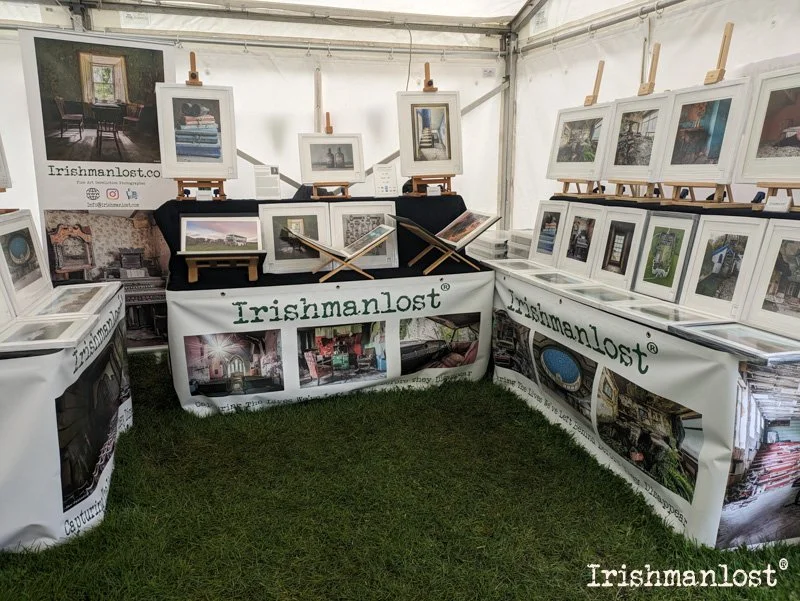
Some of my work is also available locally at Hare and Hawthorne in Coleraine, where you can see certain prints in person and purchase them directly from the store. Additionally, I regularly attend Artisan Markets, offering prints for sale and giving people the chance to see my work up close and hear some of the stories behind each image. Occasionally, I also offer work through exhibitions or partner galleries, with details shared on my website and social channels when these opportunities arise.
-
If you enjoy my work, one way to support it is through Buy Me a Coffee. I’ve been self-funding this project for over two decades, exploring and photographing abandoned and forgotten places across Ireland. With rising costs over the years, every contribution helps cover travel, equipment, film, and the research that goes into each location.
-
I use Royal Mail and Parcelforce to ship all orders, depending on size and destination. Royal Mail is typically used for smaller or standard deliveries within the UK, while Parcelforce handles larger items or faster shipping. Tracking is always provided, and all prints are carefully packaged to ensure they arrive safely.
-
I take great care to ensure that every fine art print and framed piece arrives exactly as it should. For that reason, I’m unable to offer returns or refunds on purchases. Each order is carefully inspected and securely packaged to help protect it during transit.
If, however, your item arrives damaged, I sincerely apologise for the inconvenience. Please get in touch with me as soon as possible and include clear photographs of both the packaging and the damaged item. Once I’ve reviewed the images, I’ll arrange a replacement at no additional cost to you.
Your support means a great deal to me, and I’ll always do my best to resolve any issues quickly and fairly.
-
Irishmanlost aims to remain politically neutral. Where places have more than one commonly used name, we may use Derry, Londonderry, or Derry/Londonderry depending on historical context, local usage, or to help visitors find the information they're looking for.
Many abandoned locations have no recognised name, no recorded address, or very little documented history. In these cases, we use the most accurate information available, such as the nearest town, townland, parish, or county. Some titles are descriptive names inspired by a distinctive feature, object, or characteristic of the location to help identify it. These are not intended to be official names. As new information, photographs, or historical records become available, we update our articles whenever possible.